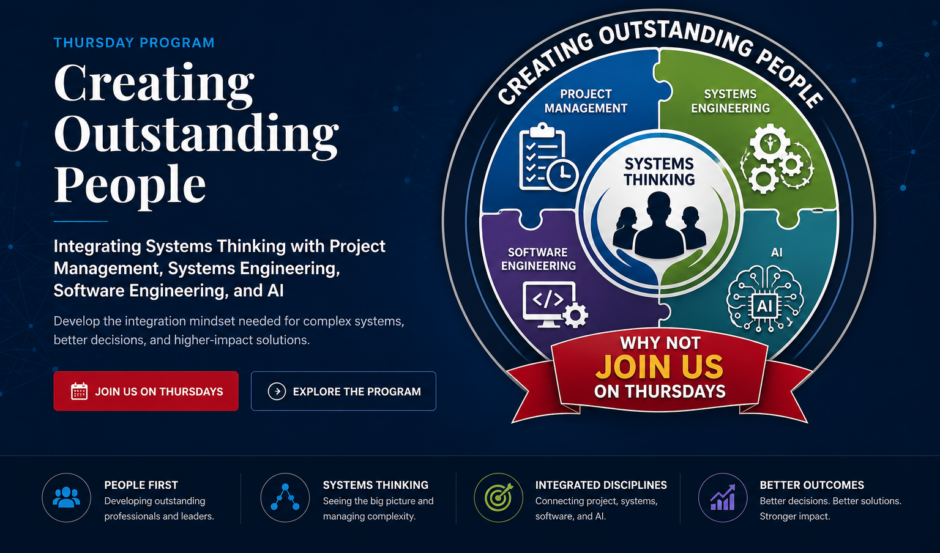
-
I'm normally on line Thursdays at 9.30 pm London local time and 7 pm New York local time in the OASIS café at Zoom Meeting (office hours for drop in chats)
-
Meeting ID: 873 4055 1993
Passcode: 557756 -
Link https://us02web.zoom.us/j/87340551993?pwd=dW5HdU1hNlpPWGNDeWQrT2F6bzR3Zz09
-
Podcasts on systems engineering and systems thinking -
NEW WEBINAR Overcoming the top three obstacles faced by young project managers in their first few years
From obstacles to triumphs
From obstacles to triumphs: A project manager’s early career roadmap
-
-
If you are even thinking about enrolling in training, you need to watch my YouTube video Why selecting the wrong training course could cost you $1000s
Blog Archives
Holistic Thinking and Technology Availability
The AI team take a deep dive into a technical note that critiques the Technology Readiness Level (TRL) system used by NASA and the DOD for assessing technology maturity, arguing that its focus on early-stage development is insufficient. It proposes a holistic thinking approach, advocating for a Technology Availability Window of Opportunity (TAWOO) that considers the entire technology lifecycle, from conception to obsolescence. The TAWOO incorporates a dynamic TRL (dTRL) to better predict future readiness … Continue reading
Comments Off on Holistic Thinking and Technology Availability
Holistic thinking: tools and strategies for problem solving
The AI team take a deep dive into a collection of excerpts from a book which centers around holistic and systems thinking as applied to various domains, including systems engineering, problem-solving, and decision-making. Author Joseph E. Kasser’s background in systems engineering and academia informs the text, which explores cognitive processes, communication strategies, and the nature of systems. The material presents numerous tools, techniques, and real-world examples to illustrate concepts such as brainstorming, critical thinking, and innovation. Furthermore, it examines how these … Continue reading
Comments Off on Holistic thinking: tools and strategies for problem solving
How collaboration via the World Wide Web can provide a global perspective and truly provide the student with a world-class education
Out AI team take a deep dive into a 2000 conference paper which applied systems thinking to propose solutions to the shortage of qualified instructors in graduate-level Information Technology programs. The core idea is collaborative teaming among universities, using distance education technology to leverage global expertise and overcome geographical limitations. This approach, involving various teaching formats, aims to improve course quality, update curriculum, and address intellectual property concerns. Alternative models are explored, such as a customer-contractor relationship between … Continue reading
Comments Off on How collaboration via the World Wide Web can provide a global perspective and truly provide the student with a world-class education
Improving e-learning through systems thinking: anecdotes and lessons learned
The AI team take a deep dive into a presentation made to the BCS in 2023 which details Dr. Joseph Kasser’s experiences improving e-learning, spanning from 1997 to 2022. He describes overcoming challenges in early online learning using limited technology, developing effective asynchronous and synchronous class formats, and creating innovative capstone projects. His approach involved systems engineering principles, focusing on stakeholder needs and iterative development. He highlights the evolution of his teaching methods, including a … Continue reading
Comments Off on Improving e-learning through systems thinking: anecdotes and lessons learned
Introducing the balanced classroom
The AI team take a deep dive into a research paper which explores the design and implementation of a “balanced classroom” approach to systems engineering education. The author, drawing on years of teaching experience and systems engineering principles, argues that traditional lecture-based methods are ineffective and proposes a system that integrates various pedagogical techniques, including flipped classrooms and authentic learning activities. The research investigates the effectiveness of different teaching methods and delivery modes (synchronous/asynchronous), analyzing … Continue reading
Comments Off on Introducing the balanced classroom